Staying steady in chaotic markets

Tariffs have created economic uncertainty and volatility in global markets. Global markets have seen several risk-off and risk-on phases since then. As the tariff situation continues to evolve, we expect market volatility to persist throughout. A notable feature throughout this period is that investors have rotated into defensive sectors, reflecting caution amid trade policy uncertainty. Beyond trade tensions, persistent geopolitical flashpoints have further unsettled global markets.
All of this argues for investors to position for future stress by pivoting into defensive strategies, such as a low volatility approach, to limit losses during market selloffs.
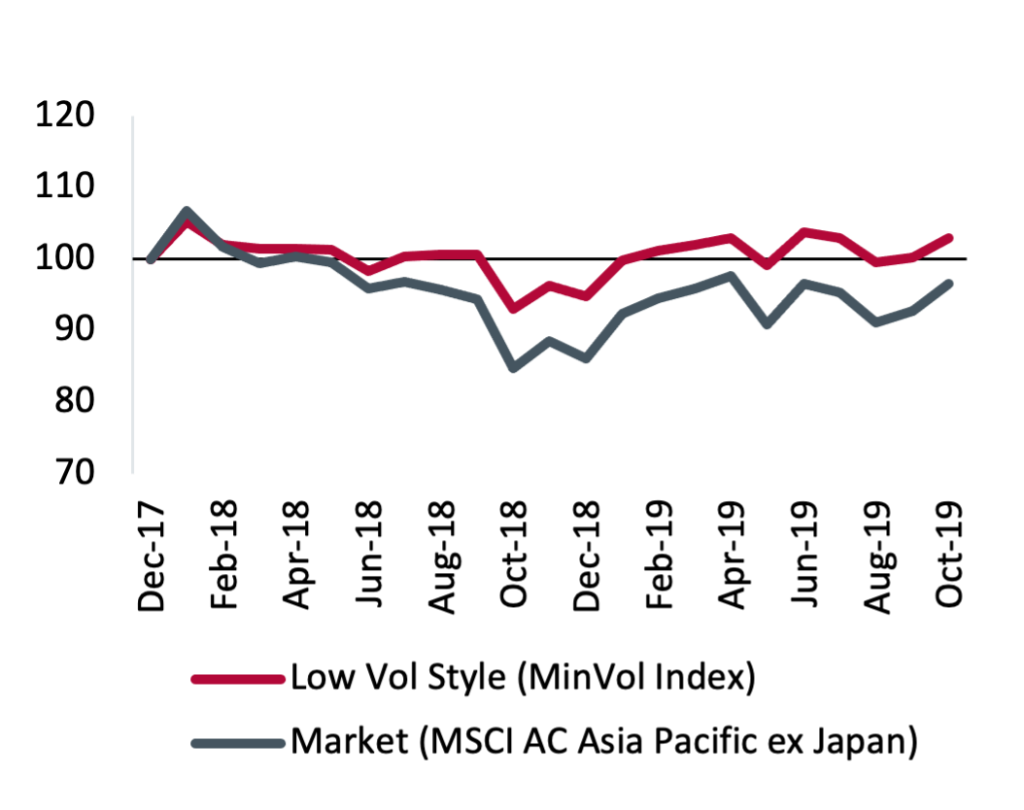
To understand this better, let’s examine how the MSCI AC Asia Pacific ex Japan Minimum Volatility index reacted during President Trump’s first term when tariffs were imposed in 2018. Equity markets directly linked to the trade war experienced notable declines, particularly in the latter half of the year. Fig 1. In contrast, the Asian low vol index provided downside protection and delivered resilient performance throughout this period.
Fig 1: Impact of tariffs during the 2018 US-China trade war
Source: LSEG DataStream, MSCI, S&P, Eastspring Investments, Feb 2025
A low vol strategy is inherently defensive
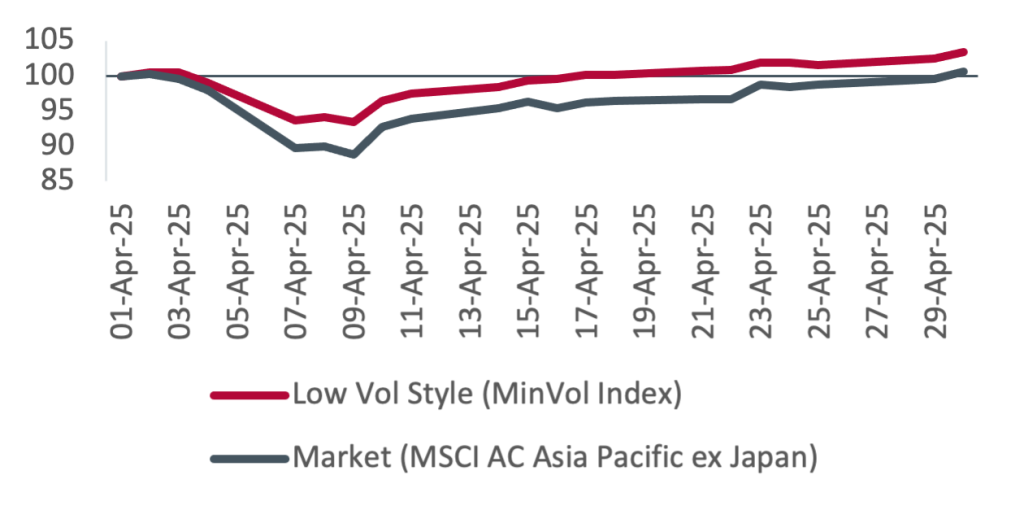
In April this year, despite a spike in market volatility following President Trump’s announcement of the “Liberation Day” tariffs, low vol style exhibited strong downside protection. Fig 2.
Fig 2: Low vol strategy offers downside protection
Source: Bloomberg, Eastspring Investments, May 2025
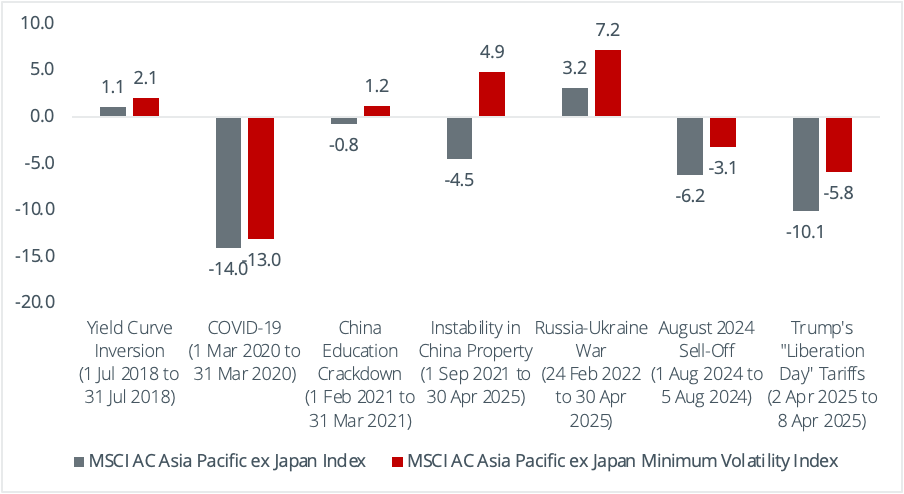
This defensive quality is not limited to isolated events. Historically, low vol has shown resilience across a range of volatile periods, including exogenous shocks like the COVID-19 pandemic and geopolitical crises such as the Russia-Ukraine conflict. In each case, low vol not only mitigated losses but often delivered more stable returns relative to the broader market, reinforcing its role as a core component of a risk-aware investment approach. Fig 3.
Fig 3: Impact of turbulent events on indices
Source: Bloomberg, Eastspring Investments, May 2025
Active bets can help navigate idiosyncratic risks
Active positioning within a low volatility framework can play a crucial role in managing idiosyncratic risks, particularly those arising from trade policy shifts or geopolitical uncertainty. Tariffs, for instance, tend to disproportionately affect cyclical and export-reliant sectors, areas that low volatility portfolios typically underweight.
By contrast, the low volatility style tends to favour more stable, non-cyclical industries that are less exposed to global trade dynamics. Defensive sectors such as utilities, telecommunications, consumer staples, and select financials are often overweighted in such strategies, offering a degree of insulation from external shocks.
Conversely, sectors with significant exposure to US revenues, such as software, industrials, technology, and commodities are generally underrepresented, reflecting their heightened sensitivity to trade disruptions. Moreover, active allocations to markets with a domestic demand bias can further mitigate exposure to global volatility. This episode underscores the importance of a diversified and defensive approach. Incorporating low volatility style with targeted, active bets can help buffer portfolios against downside risks and support more stable returns in 2025.
Contributed by: Eastspring Investments (Singapore) Limited
Website: Asset Management Singapore | Eastspring Investments
Date: May 2025
