Is Your Income Keeping Pace with Rising Costs?
High inflation looks likely to linger for months or even years. To preserve their purchasing power, Asian investors are turning to investment grade bond funds
31 October 2022
An article brought to you by UOB Asset Management Ltd.
As we enter an endemic phase of Covid-19, and with most lockdown measures now lifted, the world had been looking forward to a global economic recovery. Instead, developed economies, starting with the US and Europe, are seeing record high inflation.
Closer to home, many of us in Asia have also started to feel the pinch. In Singapore for example, inflation has surged to its highest level in 14 years (Source: Bloomberg, “Singapore Inflation at Highest in 14 Years on Food, Fuel”, August 2022). As a result, most Asians are now forced to fork out more for everyday expenses, ranging from groceries to petrol.
5 reasons why high inflation is a problem
#1: An increase in the inflation rate is a decrease in your purchasing power. The higher the inflation rate, the more money you need to pay for the same product or service.
#2: Central banks tend to raise interest rates to try to stem inflation. However, this tends to slow economic growth, which in turn can result in company closures and job losses.
#3: Inflation also raises the cost of government services. To pay for this, governments are often forced to hike income tax and/or Goods and Services Tax (GST). This further depletes consumers’ purchasing power.
#4: The US dollar (USD) has gained strength relative to many Asian currencies. This means that imports priced in USD are becoming more expensive, which puts more upward pressure on prices.
#5: Asian economies generally enjoy good capital inflows. But a strong US dollar and high global bond yields can cause capital to flow out instead, further weakening the economy.
Cash loses its value over time
If your money is not earning a return, high inflation will erode the value of your monthly income and savings. Of course, it is useful to hold some cash as a buffer against unexpected events. Experts usually advice individuals to hold six months’ worth of their monthly income or expenses in cash.
But cash depreciates in value over time. Over 20 years, even assuming a relatively low and stable inflation rate of 2 percent (this is the target for most developed country central banks) and no interest on cash savings, your $100,000 cash savings will be worth just $67,000.
Fixed deposits: Lagging behind inflation rates
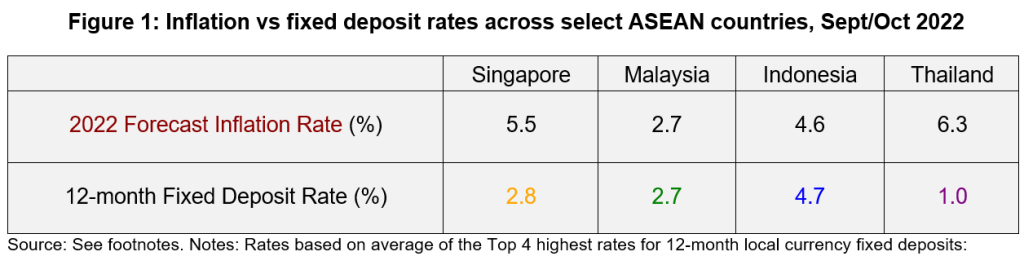
Fixed deposits (FD) in Asia have become more popular in recent months given the rise in banks’ interest rates off their multi-year lows. However, in many cases, inflation rates are rising faster than FD rates. As a result, there can be a significant shortfall in FD rates compared to prevailing inflation rates we are facing today.
Why invest in short duration, investment grade bond funds?
- A hedge against rising prices
While bond prices have come under pressure this year due to the rise in interest rates, we expect this to ease in coming months, and could even rise in the event of a recession. These bond funds are therefore an option for those seeking above-inflation returns.
- Asian investment grade bond yields at all-time highs
In October 2022, the Bloomberg Barclays Asia Investment Grade Index showed an average Yield to Worst (YTW), that is, the lowest possible yield from purchasing a bond short of a default, of 6.31 percent. This is the highest ever level achieved since the index was incepted in 2009 at a previous high of 5.19 percent.
- Higher returns for bonds with shorter maturity periods
Long term bonds typically offer higher yields than short term bonds. But the US Treasury yield curve is currently inverted, which means that short-term bond yields are now higher than long-term bond yields. As of 31 October 2022, the spread, ie the yield differential between 10-year and 2 year US Treasuries was -0.42 percent. As a result, short duration investment grade bond funds are able to offer more attractive income than long-term funds with the same credit risk profile.
The United SGD Fund: Highlights
- High grade, short duration
This fund has an effective duration of about 1.33 years (as of 31 October 2022), and invests in high grade, short-term debt securities. The fund mainly focuses on investments in Asia given the opportunities in the region and its objective is to achieve a yield enhancement over Singapore dollar deposits.
- Higher yield, lower volatility
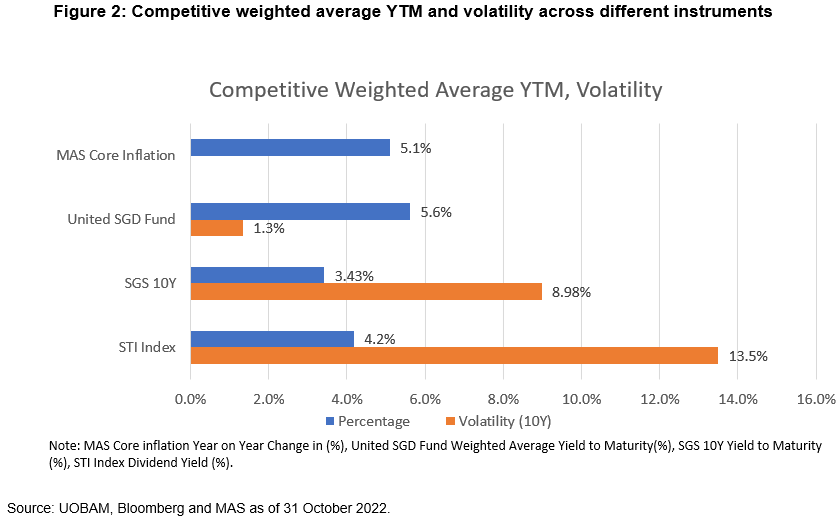
When compared to Singapore 10 Year Government Bonds (SGS 10Y) and the Singapore Straits Times Index (STI Index), the United SGD Fund offers a higher weighted average yield to maturity (YTM), despite demonstrating lower volatility
- Above-inflation yields
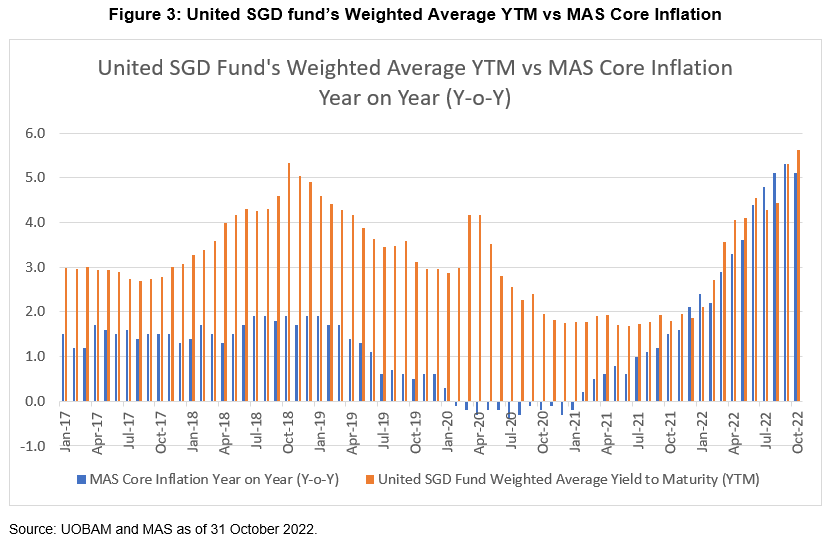
Despite its short duration, the United SGD fund has been able to consistently deliver inflation-beating yields, and continues to do so even amid the inflation surges seen in recent times.
- Able to ride the rising rates momentum
The fund utilizes a laddered investment strategy. By staggering the maturity of the bonds in its portfolio, the principal from matured bonds can be re-invested into ones that are higher-yielding. This is very useful in the current environment because the fund is able to take advantage of rising rates while limiting the duration of the portfolio.
Footnotes:
Source: ADB Data Library, Inflation Rate in Asia and the Pacific, Asian Development Outlook (ADO), September 2022
Source: Singsaver, 13 Best Fixed Deposit from Top Banks in Singapore To Lock In Your Savings (October 2022), October 2022
Source: RinggitPlus, Best 12 Month FD Rates, October 2022
Source: Kontan.co.id, Suku Bunga Deposito Lhbu (Laporan Harian Bank Umum), October 2022
Source: Bank of Thailand, Deposit Rates for Individuals of Commercial Banks, October 2022
Source: Bloomberg, 31 October 2022
Source: CNBC, 31 October 2022
Fund details as of 31 October 2022
| United SGD Fund | |
| Weighted average yield to maturity (in SGD terms) | 5.62% |
| Effective duration | 1.33 years |
| Number of Issues | 83 |
| Country allocation | China – 25.06% Hong Kong – 12.63% Singapore – 12.61% South Korea – 8.75% Indonesia – 8.38% India – 6.99% Japan – 6.28% Thailand – 5.99% Others – 12.78% Cash – 0.52% |
| Top sector allocation | Financials – 35.12% Industrials – 17.15% Utilities – 13.14% Consumer Discretionary – 9.70% Materials – 8.26% |
| Top 5 holdings | Mizuho Financial Group Cayman 3 – 2.49% Sumitomo Mitsui Financial – 2.30% Bank Rakyat Indonesia – 2.26% Minor International PCL – 2.17% China Huadian Overseas – 2.02% |
| Benchmark Index | Since Inception – 2 May 2021: 6-month SIBID rate 3 May 2021 – 7 April 2022: 12M Bank Deposit Rate 8 April – Present: 6M Compounded SORA |
| Inception date | Class A (Acc) SGD: 19 June 1998 Class A (Dist) SGD: 13 March 2014 Class A (Acc) USD (Hedged): 16 February 2016 Class A (Dist) USD (Hedged): 16 February 2016 |
| Minimum Investment | S$1,000/US$1,000 (initial) S$500/US$500 (subsequent) |
| Fees | Subscription fee: currently up to 2%; maximum 5% Management fee: Currently 0.63% p.a., maximum 1.5% p.a. |
Important Notice & Disclaimers: All information in this publication is based upon certain assumptions and analysis of information available as at the date of the publication and reflects prevailing conditions and UOB Asset Management Ltd (“UOBAM”)’s views as of such date, all of which are subject to change at any time without notice. Although care has been taken to ensure the accuracy of information contained in this publication, UOBAM makes no representation or warranty of any kind, express, implied or statutory, and shall not be responsible or liable for the accuracy or completeness of the information.
Potential investors should read the prospectus of the fund(s) (the “Fund(s)”) which is available and may be obtained from UOBAM or any of its appointed distributors, before deciding whether to subscribe for or purchase units in the Fund(s). Returns on the units are not guaranteed. The value of the units and the income from them, if any, may fall as well as rise. Please note that the graphs, charts, formulae or other devices set out or referred to in this document cannot, in and of itself, be used to determine and will not assist any person in deciding which investment product to buy or sell, or when to buy or sell an investment product. An investment in the Fund(s) is subject to investment risks and foreign exchange risks, including the possible loss of the principal amount invested. Investors should consider carefully the risks of investing in the Fund(s) and may wish to seek advice from a financial adviser before making a commitment to invest in the Fund(s). Should you choose not to seek advice from a financial adviser, you should consider carefully whether the Fund(s) is suitable for you. Investors should note that the past performance of any investment product, manager, company, entity or UOBAM mentioned in this publication, and any prediction, projection or forecast on the economy, stock market, bond market or the economic trends of the markets is not necessarily indicative of the future or likely performance of any investment product, manager, company, entity or UOBAM or the economy, stock market, bond market or economic trends of the markets. Nothing in this publication shall constitute a continuing representation or give rise to any implication that there has not been or that there will not be any change affecting the Funds. All subscription for the units in the Fund(s) must be made on the application forms accompanying the prospectus of that fund.
The above information is strictly for general information only and is not an offer, solicitation advice or recommendation to buy or sell any investment product or invest in any company. This publication should not be construed as accounting, legal, regulatory, tax, financial or other advice. Investments in unit trusts are not obligations of, deposits in, or guaranteed or insured by United Overseas Bank Limited, UOBAM, or any of their subsidiary, associate or affiliate or their distributors. The Fund(s) may use or invest in financial derivative instruments and you should be aware of the risks associated with investments in financial derivative instruments which are described in the Fund(s)’ prospectus.
In the event of any discrepancy between the English and Mandarin versions of this publication, the English version shall prevail.
This advertisement or publication has not been reviewed by the Monetary Authority of Singapore.
UOB Asset Management Ltd Co. Reg. No. 198600120Z

