The Importance of Scenario Planning for Investments: Adapting to Global Market Developments
Brought to you by Tokio Marine Life Insurance Singapore Ltd.
Investing in financial markets involves managing uncertainty, as economic conditions, geopolitical events, and central bank policies can shift market dynamics unexpectedly. Scenario planning helps investors prepare for different possibilities—bull, base, and bear markets—by ensuring their portfolios remain resilient across varying market conditions. A well-structured portfolio with a diverse range of funds enables investors to adapt effectively to these scenarios, balancing risk and opportunity while maintaining long-term financial goals.
Why Scenario Planning Matters for Investors
- Reduces Emotional Investing
Investors can make impulsive decisions based on market sentiment. A structured plan, like an investment-linked plan, promotes discipline and mitigates reactionary mistakes. - Builds Portfolio Resilience
A diversified mix of funds enhances portfolio stability, ensuring investments continue to perform across different economic conditions and reducing volatility. - Enhances Decision-Making
Scenario planning empowers investors to make informed choices rather than reacting to short-term market fluctuations. - Adapts to Global Uncertainty
Economic cycles are influenced by central bank policies, inflation trends, and global events, including geopolitical tensions and technological shifts. A flexible fund selection enables investors to adjust their strategy without overhauling their entire portfolio.
Key Market Scenarios and the Role of Fund Diversification
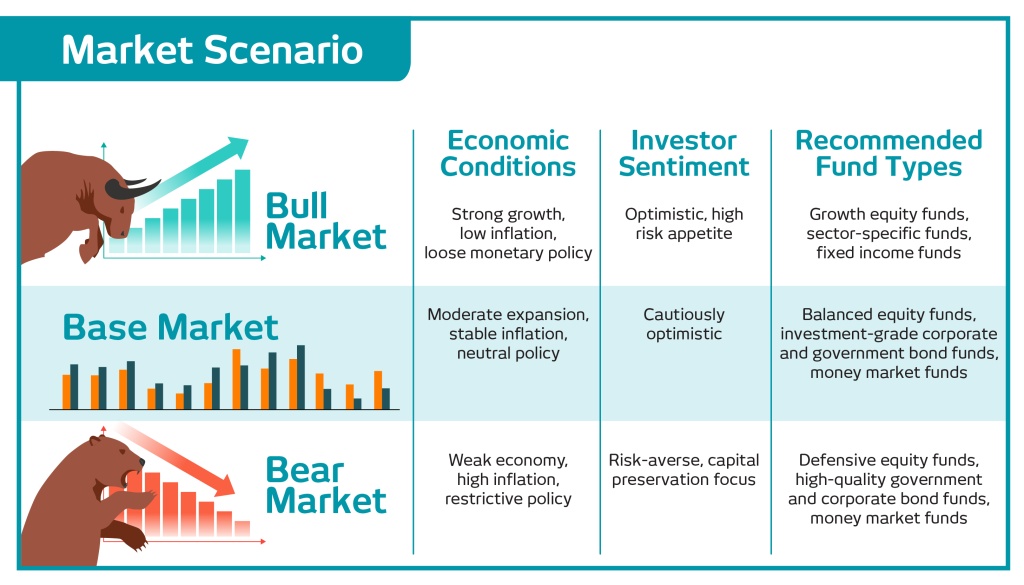
1. Bull Market Scenario (Optimistic Outlook)
A bull market is typically characterised by strong economic growth, benign inflation, and accommodative monetary policy. An investment strategy that favours higher exposure to growth-oriented investments, paired with the right fund selection, can maximise potential gains. These include:
● Growth Equity Funds: Focus on growth sectors and emerging markets that tend to outperform in strong economic conditions.
● Sector-Specific Funds: Target sectors with high-growth potential, such as artificial intelligence, healthcare, and consumer discretionary.
● Fixed Income Funds: Allocate to short-duration bond funds or high-yield corporate bond funds for stability while benefitting from economic expansion.
2. Base Market Scenario (Neutral/Moderate Growth Outlook)
In a base market, global economies see moderate expansion, stable inflation, and neutral central bank policies. As economic headwinds may arise, investors often take a cautiously optimistic approach, adjusting their allocations between high-growth and defensive sectors. Key strategies include:
● Balanced Equity Funds: Large-cap and dividend-focused equity funds provide stability and growth.
● Bond Funds: Investment-grade corporate and government bond funds generate income while reducing portfolio volatility.
● Money Market Funds: Liquidity allows investors to capitalise on market dips.
3. Bear Market Scenario (Pessimistic Outlook)
A bear market often sees elevated market volatility due to weak economic prospects, persistent inflation, and restrictive monetary policies. Price instability erodes consumer and business confidence, slowing economic growth. A bear market requires capital preservation and defensive positioning, such as:
● Defensive Equity Funds: Invest in companies with stable cash flows and earnings resilient to economic downturns.
● Bond Funds: Allocate to high-quality government and high-grade corporate bond funds for steady income and downside protection.
● Money Market Funds: Ensure liquidity while minimising downside risk.
How a Good Fund Range Supports Investors Across Market Cycles
- Flexibility to Adjust Portfolio Weightings
● A mix of equity, bond, and sector funds allows investors to shift weightings depending on market conditions.
● Investors can increase growth fund exposure in bull markets while rotating into defensive funds in downturns. - Reducing Volatility While Maintaining Growth Potential
● Holding both growth and defensive funds ensures that a portfolio remains resilient in uncertain times.
● Bonds and dividend-focused funds help stabilise returns when equity markets are volatile. - Ability to Capture Thematic Opportunities
● Sector-specific and thematic funds enable investors to capitalise on long-term trends, such as technology and healthcare investing.
● These funds provide targeted exposure without requiring deep market expertise in individual stocks.
Conclusion: Using Fund Diversification for Effective Scenario Planning

Scenario planning is essential for long-term investment success. Armed with a diversified selection of funds will allow investors to:
● Adjust fund allocations across different economic conditions based on bull, base, or bear market scenarios.
● Reduce downside risks by incorporating defensive attributes into their portfolio through bond and money market funds.
● Maintain flexibility to capture emerging opportunities while preserving capital.
Tokio Marine offers a curated selection of ILP sub-funds, allowing investors’ portfolios to adapt dynamically and focus on long-term growth. Through Tokio Marine’s investment-linked plans, investors will have access to exclusive funds managed by top global fund managers with strong institutional expertise. While the future is uncertain, structured planning ensures investors have the tools to navigate the complex financial landscape and remain well-prepared in an evolving global market.
Connect with our Financial Representative or visit tokiomarine.com to learn more about our investment-linked plans.
Terms and conditions apply.
Disclaimer
The information contained within this article has been obtained from sources that Tokio Marine Life Insurance Singapore Ltd. (TMLS) believes to be reliable and accurate but no representation or warranty, expressed or implied, is made as to the fairness, accuracy, completeness or correctness of the information.
Neither TMLS nor its associates, partners nor employees accept any liability whatsoever for any loss arising directly or indirectly from the use of this article.
This is for general information only and does not have regard to your specific investment objectives, financial situation, and any of your particular needs. Information on any specific product in this article is not a contract of insurance and is not intended as an offer or recommendation to purchase the plan. You should seek advice from a financial adviser before making a commitment to purchase any insurance plan.
The information in this article may not be reproduced in whole or in part without the prior written consent of TMLS.
Protected up to specified limits by the Singapore Deposit Insurance Corporation (SDIC). This advertisement has not been reviewed by the Monetary Authority of Singapore.